
Dubai property inheritance comes down to one fact: the UAE charges no inheritance tax, but the law still decides who gets your home unless you plan ahead. Without a registered will, non-Muslims living in the UAE split by a fixed formula, and Muslims by Sharia shares. Your home country may also tax the same property. A US citizen can owe 40% above USD 15 million. A UK long-term resident can owe 40% too. This guide shows the three ways to hold Dubai property (your own name with a will, a company, or a foundation), what each costs, and where each one fails.
Dubai property inheritance at a glance:
- The Short Answer
- How Dubai property inheritance works when there is no plan
- After a death: three things families get wrong
- Dubai compared with the world
- Your home country may still tax your Dubai property
- Four families, four outcomes
- Route 1: your own name, plus a registered will
- Route 2: holding through a company
- Route 3: a family foundation
- The three routes side by side
- Before you book: buying through a company in practice
- Golden Visa, mortgages and privacy
- Gulf and Muslim families: keeping the property in the family
- Seven-point checklist before you sign
- Frequently asked questions
- Plan the owner before you buy the home
The Short Answer
Dubai does not tax what you leave behind. That part is true, and it is rare among the world’s wealth centres.
But “no tax” does not mean “no rules”. The name on your title deed decides three things:
- which rules split the property when you die
- how long your family waits before they can sell, rent or refinance it
- how much of your ownership the public can see
You have three main routes:
- Hold in your own name and register a will.
- Use a company to own it.
- Place it in a foundation or, for Gulf families, a family waqf.
Each route trades cost and simplicity against control and privacy. The right one depends on your passport, where your heirs live, and how many properties you own. The rest of this guide gives you the facts to choose, with a source for every rule.
How Dubai property inheritance works when there is no plan
Without a registered will, UAE law picks your heirs. Your family also needs a court before anything moves. Which law applies depends on your religion.
If you are not Muslim
Since 1 February 2023, Federal Decree-Law No. 41 of 2022 covers non-Muslim UAE citizens and non-Muslim foreigners who live in the UAE. With no will, Article 11 splits the estate like this:
- Half goes to the husband or wife.
- The other half goes to the children in equal shares. The law treats sons and daughters the same.
- With no children, the law gives the estate to the parents in equal shares. If only one parent is alive, that parent takes half and the brothers and sisters share the other half. The official English text does not say clearly how a surviving spouse fits in here, which is one more reason to write a will.
Why a registered will matters
Two parts of that law matter more than the split.
First, a will is powerful. Article 11 lets you leave “the entire property he owns in the State” to anyone you choose.
Second, any heir of a foreigner can ask the court to apply the law the Civil Code points to, which is usually the law of the home country. That right stops when “there is a registered will to the contrary”. So without a will, one heir can change which law splits your estate. A registered UAE will closes that door.
If you own Dubai property but live abroad, it is less clear which rules apply. A registered will removes that doubt.
For property, UAE law has the last word. The new Civil Transactions Law, in force since 1 June 2026, says UAE law applies “to a will made by a foreigner concerning their immovable property located in the State”. Dubai’s own Law No. 15 of 2017 says the same for property in Dubai.
The Civil Transactions Law also covers a foreigner who leaves no heir at all. Under Article 17(2), that person’s UAE assets become a charitable endowment, or waqf, under government oversight. Dying without a will is not the same as dying without heirs, though. If you leave a spouse, children or parents, Article 11 still gives the property to them.
If you are Muslim
For Muslims, Sharia shares apply. The current Personal Status Law, Federal Decree-Law No. 41 of 2024, took effect on 15 April 2025. Under Article 173, a will can pass up to one third of the estate, after funeral costs and debts. A will above that needs the heirs’ approval.
What your family has to do
- Get the inheritance certificate. Dubai set up a Probate Court in 2023 to hear most estate claims. If the owner left a will registered with the DIFC Courts, the DIFC Courts handle probate instead.
- Transfer the title deed. The Dubai Land Department (DLD) moves the property into the heirs’ names only with the inheritance certificate and an official court letter. The fee is AED 1,000 per property, plus AED 250 for each new title deed and small map and service fees, per the DLD.
- Deal with the bank. Under a 2020 federal rule, other joint holders had to tell the bank of a death within ten days. The bank then froze the dead person’s share until a successor was in place (see Federal Decree-Law No. 14 of 2020). That law was replaced in 2023, so ask your bank how it handles a death today.
While this runs, service charges and mortgage payments do not stop.
When heirs disagree
Shared ownership is where most family trouble starts. For homes, Dubai has a set process under Decree No. 23 of 2020, as amended in 2023:
- One heir can apply to the DLD to sell.
- The other heirs have 30 days to agree.
- Without agreement, the DLD tries to mediate.
- Where the property cannot be divided, the Probate Court can order an auction.
If one heir is a child, selling gets slower. A guardian cannot sell a minor’s property without a court’s permission, under Article 137 of the Personal Status Law.

After a death: three things families get wrong
The court steps above are only half the story. In practice, three mistakes cost families the most time.
A power of attorney stops when the owner dies
Many owners give a spouse or a child a power of attorney. They expect it to let the family sell after a death. It will not. Under UAE civil law, an agency ends when the person who gave it dies. From that day, the agent has no power to sign for the owner, at the DLD or anywhere else.
So the heirs must take the court route above instead. A power of attorney still helps while you are alive, for example if you live abroad. But it cannot replace a registered will.
The tenant stays
If the property is rented, the lease does not end when the landlord dies. Article 27 of Dubai Law No. 26 of 2007 says the lease carries on with the heirs. In effect, the heirs become the landlord, with the same rights and duties.
This matters if the family wants to sell the home empty. The death itself is not a reason to end the lease. To get the home back when the lease ends, the heirs need a ground under Article 25(2), as amended by Law No. 33 of 2008:
- Selling the property is one ground.
- Moving in, or housing a first-degree relative, is another. Here the owner must prove they have no other suitable property.
In both cases, the heirs must give 12 months’ notice before the eviction date, through a notary public or by registered mail. So check the lease dates early. Our guide to buying a tenanted apartment shows the same rules from the buyer’s side.
Papers from abroad need attestation
If the owner dies outside the UAE, the family proves the death and the family ties with foreign papers. A death certificate, a marriage certificate and birth certificates are the usual set. Each one must first be attested by the foreign ministry of the country that issued it, then by the UAE embassy or consulate there. Then the UAE Ministry of Foreign Affairs attests it, for AED 150 per personal document, per MOFA.
Dubai Courts work in Arabic, so foreign papers also need a legal translation into Arabic. The DIFC Courts, by contrast, work in English under Rule 2.2 of their rules. But they only handle estates where the owner registered a DIFC will. That is one more reason to register a will while you can. Either way, start ordering the papers early.
Dubai compared with the world
On tax, Dubai property inheritance starts from zero. The UAE has no inheritance, estate or gift tax on individuals, per PwC. In the UK or the US, a large estate can pay 40% on the part above the tax-free allowance. In France, children can pay up to 45%.

| Country | Tax at death (2026) | Main exemptions | Fixed shares for family? |
|---|---|---|---|
| UAE | None | Not needed | Sharia shares for Muslims; non-Muslims can leave all UAE assets by will |
| Saudi Arabia | None | Not needed | Sharia shares |
| Qatar | None | Not needed | Sharia shares |
| Singapore | None since 15 Feb 2008 | Not needed | No; some family can claim maintenance |
| Hong Kong | None since 11 Feb 2006 | Not needed | No; family and dependants can claim |
| Monaco | 0% to 16% | Spouse and children pay 0% | Yes, but foreigners can usually choose the law of their nationality in a will |
| Switzerland | Set by each canton | Spouse exempt everywhere; children exempt in most cantons | Yes, reduced in 2023 |
| Italy | 4% to 8% | Spouse and children: first EUR 1 million each | Yes |
| United Kingdom | 40% | Spouse usually exempt (limits apply if the spouse is not a long-term UK resident); GBP 325,000, plus up to GBP 175,000 for a home left to children or grandchildren, reduced for estates over GBP 2 million | No; family can claim reasonable provision |
| France | Up to 45% for children | Spouse exempt; EUR 100,000 per child, per parent | Yes: children reserve half to three quarters |
| United States | 40% federal | Spouse, if a US citizen; USD 15 million per person in 2026 for US citizens and US-domiciled residents | No federal rule |
Speed differs too. In England, families usually get probate within 12 weeks of applying, per GOV.UK. In the DIFC, a simple grant “is normally issued within a matter of a few weeks”, per the DIFC Courts.
Your home country may still tax your Dubai property
Dubai property inheritance does not end at the UAE border. The UAE does not tax your estate, but your home country might. Many tax systems follow the person, not the property. So a Dubai villa can still end up in a tax bill in Washington, London or Berlin. Of the 21 home countries checked below, 9 can still tax a Dubai home as inheritance.

| Where you or your heirs are connected | Does it reach your Dubai property? | What triggers it |
|---|---|---|
| United States | Yes | US citizens and US-domiciled residents are taxed on property “wherever situated”. 40% above USD 15 million in 2026 |
| United Kingdom | Yes, for long-term residents | UK resident for 10 of the previous 20 tax years. It lasts 3 to 10 years after you leave. 40% |
| France | Generally no, if you own it directly | The France and UAE treaty taxes real estate only where it sits. Company shares are treated differently |
| Germany | Yes | The person who died or the heir lives in Germany. German nationals stay liable for 5 years after moving abroad. 7% to 30% for close family |
| Spain | Yes, through the heir | Heirs living in Spain are taxed on what they inherit, wherever it is. Regional reliefs can cut the bill |
| Italy | Yes | The person who died lived in Italy. 4% above EUR 1 million per close heir |
| Netherlands | Yes | The person lived in the Netherlands, or was Dutch and left less than 10 years before death |
| Belgium | Yes | The person lived in Belgium. Rates depend on the region |
| Japan | Often yes | Heirs living in Japan are usually taxed on everything, with relief for some short-stay foreign residents. Heirs abroad can be caught too, depending on where they and the person who died lived in the last 10 years. Up to 55% |
| South Korea | Yes | The person lived in Korea. Up to 50% |
| Canada | Yes, as capital gains tax | No inheritance tax, but residents are treated as selling everything at death. Property left to a Canadian-resident spouse can roll over |
| Australia | Sometimes, as capital gains tax | No inheritance tax. If the person who died lived in Australia, capital gains tax can apply when the property passes to an heir living abroad |
| Switzerland | Generally no | Real estate is taxed where it sits, so foreign property is generally outside Swiss inheritance tax |
| India, China, Pakistan | No | No inheritance tax |
| Saudi Arabia, Qatar, Kuwait, Bahrain, Oman | No | No inheritance tax (Kuwait, Bahrain and Oman per Deloitte country tax highlights) |

Four traps for international families:
1. No treaty and no credit
Tax treaties and credits usually stop two countries taxing the same estate. But a credit only covers tax actually paid abroad, and the UAE charges none. The UAE is also missing from the US estate tax treaty list and the UK inheritance tax treaty list. France is the main exception, through its 1989 treaty with the UAE.
2. A company does not hide the property from your home country
A US citizen who owns a Dubai company still owns its shares. So does a UK long-term resident. Their home country taxes the shares instead of the villa, under US Code section 2031 and UK Inheritance Tax Act section 6. For a French resident, a company can make things worse. The treaty protects real estate held directly, but taxes company shares where the owner lived (Article 17).
3. A foreign spouse can lose the spouse exemption
- US: property left to a spouse who is not a US citizen gets no marital deduction, unless it goes into a qualified domestic trust. That trust only delays the tax, per US Code section 2056. Gifts to a non-citizen spouse are tax free up to USD 194,000 a year in 2026. Larger gifts use up part of the USD 15 million exclusion, per the IRS.
- UK: if you are a long-term resident and your spouse is not, the UK caps the spouse exemption at GBP 325,000, per HMRC. Your spouse can elect to be treated as a long-term resident, but then their own worldwide assets come into UK tax. See what the election means.
4. Gifting the villa but still living in it rarely works for UK long-term residents
This matters if you are a UK long-term resident. A lifetime gift usually leaves your UK estate only if you live 7 more years. If you keep living in the villa without paying a full market rent, it still counts as yours, per GOV.UK.
The lesson: plan around the family’s passports and homes, not around Dubai alone. If you are British, our guide to life in Dubai as a British expat covers the move itself.
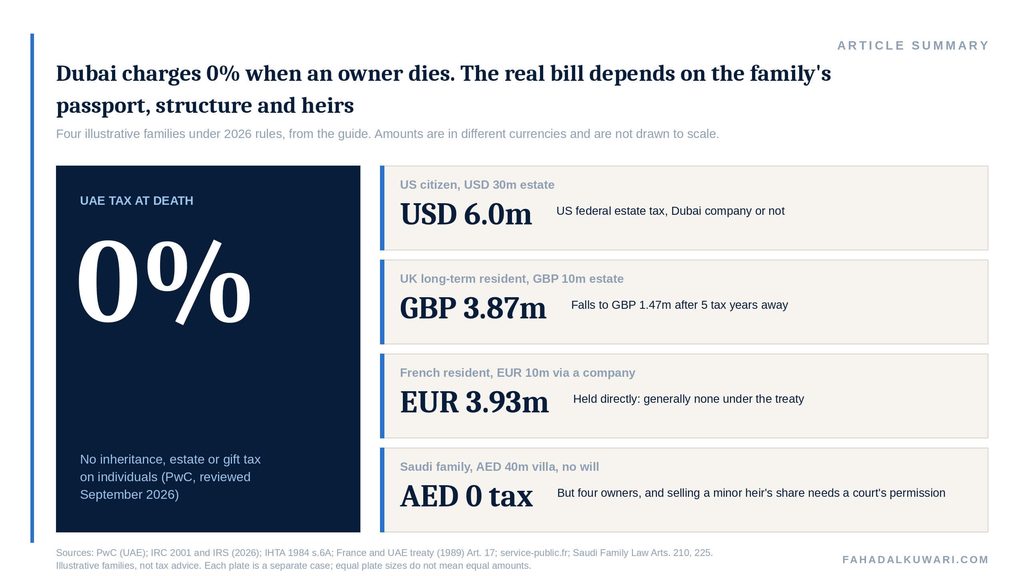
Four families, four outcomes
Rules on Dubai property inheritance are easier to judge with numbers. These four worked examples, prepared by Fahad Al Kuwari, use the 2026 rules above. Each one keeps things simple: no debts, no lifetime gifts and no other reliefs. Use them to see the size of the issue, not as tax advice.

1. American family living in Dubai
US citizen dies owning USD 30 million worldwide, including a USD 20 million Dubai villa. Everything goes to the children.
- US federal estate tax: USD 6 million. The 2026 exclusion covers the first USD 15 million. The US then taxes the other USD 15 million at 40%, under US Code section 2001 and the IRS Form 706 instructions.
- Holding the villa through a Dubai company changes nothing. The shares are still in the US estate.
- If everything goes to a US-citizen spouse, no tax is due at the first death. If the spouse is not a US citizen, the estate loses the marital deduction unless it uses a qualified domestic trust. That only delays the tax.
2. British family that moved to Dubai
Couple lived in the UK for 15 years, then moved to Dubai. The husband dies owning GBP 10 million: a GBP 6 million Dubai villa and GBP 4 million of UK assets. Everything goes to the children.
| When he dies | UK inheritance tax | Why |
|---|---|---|
| Before 5 full tax years of non-UK residence | GBP 3.87 million | Still a long-term resident, so the Dubai villa is taxed. 40% above GBP 325,000. The home allowance is lost above GBP 2.35 million |
| After 5 full tax years away | GBP 1.47 million | No longer a long-term resident, so only the UK assets are taxed |
Timing alone moves GBP 2.4 million. With 15 years of UK residence, the law needs 5 tax years in a row of living abroad before the worldwide charge ends, under section 6A. People who left before April 2025 follow transitional rules.

| Years you lived in the UK (of the last 20) | Years abroad before the worldwide charge ends |
|---|---|
| 13 or fewer | 3 |
| 14 | 4 |
| 15 | 5 |
| 16 | 6 |
| 17 | 7 |
| 18 | 8 |
| 19 | 9 |
| 20 | 10 |
3. French-resident family
French resident leaves a EUR 10 million Dubai portfolio to two children, half each.
| How the property is held | French inheritance tax |
|---|---|
| Directly, in her own name | Generally none. The France and UAE treaty taxes real estate only where it sits (Article 17) |
| Through a company | About EUR 3.93 million. Shares are taxed where the owner lived, so each child pays about EUR 1.97 million after the EUR 100,000 allowance |
Here, the “clever” company structure costs the family nearly EUR 4 million. One caveat on the direct route: the treaty lets France take the exempt Dubai property into account when it sets the rate on other assets taxed in France (Article 19). Confirm the details with a French tax lawyer. Sources: the treaty text and the French rates.
4. Saudi family
Saudi national dies owning an AED 40 million Dubai villa, with no will. He leaves a wife, two sons and a daughter. His parents are no longer alive.
- Tax: none, in either the UAE or Saudi Arabia.
- The split follows Sharia shares. The wife takes one eighth: AED 5 million. The children share the rest, and a son takes twice a daughter’s share. That is AED 14 million for each son and AED 7 million for the daughter. Both the UAE Personal Status Law and the Saudi Family Law (Articles 210 and 215) give this split.
- The real cost is control. The villa now has four owners. If one child is a minor, selling needs a court’s permission. The family waqf and lifetime gifts covered later in this guide are how Gulf families avoid this.
The pattern is clear. For Western families, the danger is tax at home. For Gulf families, it is division and delay.
Planning a purchase above AED 10 million? Decide who should own it before you sign the reservation form. Changing the owner later costs fees, paperwork and developer approvals. A short review of your family’s passports and plans now can save a large bill later.
Route 1: your own name, plus a registered will
This is the simplest Dubai property inheritance plan, and for many owners it is enough. You buy in your own name. Then you register a will that says who gets what.

There are four places to make a will official in the UAE. Each one works differently.
| Office | Who can use it | Fee | What it does |
|---|---|---|---|
| DIFC Courts Wills Service | Non-Muslims who have never been Muslim, aged 18 or over, with UAE assets or children here | Full Will AED 10,000 (couples AED 15,000). Property Will AED 7,500 (couples AED 10,000) | Registers the will and grants probate. English common-law style |
| Abu Dhabi Judicial Department | Any non-UAE citizen, “regardless of your religion” | AED 950 (AED 2,500 for a special will) | Registers civil wills covering assets across the UAE |
| ADGM Courts | Non-Muslims | AED 950 plus USD 155 | Notarises the will only. Probate goes to the Abu Dhabi Judicial Department |
| Dubai Courts | Non-Muslims | Ask Dubai Courts | Keeps the onshore register of non-Muslim wills in Dubai |

The DIFC service is busy. It registered 922 wills in the first half of 2025, up 14% on a year earlier, and issued 27 probate orders, per the DIFC Courts.
Five facts about the DIFC Wills Service
- Pick the will that fits. A Property Will covers up to five properties in the UAE. A Full Will covers everything you own in the UAE. It can also list assets abroad, but those follow the laws of the country where they sit, per the DIFC Courts.
- Sign by video. You can register every DIFC will online by video call.
- No yearly fee. Changing a will costs AED 550. Applying for probate costs USD 1,500.
- It is quick. The DIFC Courts normally issue a simple grant of probate within a few weeks. They also work in English, so English papers need no translation.
- It reaches your Dubai property. The executor applies, through the DIFC Courts, to enforce the probate order at Dubai Courts. The Dubai Courts’ Enforcement Department then issues directions to transfer the assets, per the DIFC probate guide. This step has its own fee, so list every asset accurately.
Where this route falls short
A will still needs a court to act on it. Your name stays on the title deed. And a will does nothing for you while you are alive, for example if you lose capacity.
If you are buying your first Dubai home, our step-by-step buying guide covers the purchase itself.
Route 2: holding through a company
A company changes what your heirs inherit. Here a company owns the property, and you own the company. When you die, your heirs inherit your shares in the company, not the title deed. A company also lets several family members own one property through a single shareholding.
Which companies can own Dubai property
Dubai law limits who can own property, under Law No. 7 of 2006. Foreign companies cannot own Dubai property directly, per the DLD and Al Tamimi guide. Instead, families use UAE vehicles that the DLD has approved:
- Dubai free zone companies, such as JAFZA and DMCC companies, per the same guide.
- DIFC companies, partnerships and foundations, under an agreement with the DLD announced in May 2017, per the DLD.
- ADGM companies, under an agreement signed in October 2018 and announced in November 2018, per the DLD.
- RAK ICC and RAKEZ companies, under agreements announced in 2019. The standard route is for companies owned by individuals. The DLD may approve corporate shareholders case by case, per RAK ICC.
Expect the DLD to ask for a no objection letter from the company’s free zone registrar before it registers the purchase. Check the exact papers with the DLD and the registrar. A trust is a contract, not a company, so it cannot hold Dubai property itself. Instead, the trustee can hold shares in a company that owns the property. The DLD will ask who the trust’s beneficial owners are, per Al Tamimi.

New in 2026: a cheaper DIFC holding company
On 24 July 2026, the DIFC opened its Prescribed Company regime to any applicant. In most cases, the company must appoint a DIFC-licensed corporate service provider, per the DIFC. These are passive holding companies. The DIFC lists a one-time application fee of USD 100. The yearly licence is USD 1,000 plus a AED 20 fee, per the DIFC. On top of that, the corporate service provider charges its own fees. Law firm Trowers & Hamlins lists holding real estate and family succession among their uses.
What the DLD charges
These fees come from Dubai’s official fee schedule, Executive Council Resolution No. 30 of 2013, and current DLD service pages.
| Transaction | DLD fee |
|---|---|
| Buying a property | 4% of the price. The law splits it equally unless the parties agree otherwise, but in practice the buyer usually pays the full 4% |
| Gift to a spouse, parent, child or company | 0.125% of the value, minimum AED 2,000, per the DLD |
| Selling shares in a company that owns property | 2% from the seller and 2% from the buyer, on the sale value, per the DLD |
| Passing property to heirs | AED 1,000 per property, plus AED 250 for the title deed |
Two lessons follow.
First, a company is not a way around the 4%. The DLD charges fees on “any direct or indirect share transfer” in a company that owns Dubai property, per Al Tamimi.
Second, moving a property you own into your own company may cost only 0.125%. Al Tamimi says the DLD may apply the gift rate where the real owner does not change. But the DLD decides each case.
Route 3: a family foundation
A foundation owns the assets, and a council runs it under rules you write. The foundation does not die, so the property does not have to pass through an estate.

The DIFC foundation
The DIFC Foundations Law, DIFC Law No. 3 of 2018, sets the rules. A DIFC foundation can register Dubai property with the DLD.
What the law requires:
- a charter, written in English
- by-laws, which stay off the public register
- a council of at least two members (the founder can sit on it)
- a registered office in the DIFC (a registered agent is optional)
What it offers families:
- Protection from foreign claims. A gift of property to the foundation that is valid under DIFC law cannot be set aside “by reference to a Foreign Law” (Article 14). The exception is a gift made to defraud a creditor. A court must find that intent, and the foundation’s liability is limited to what was transferred.
- Protection from foreign heirship rules. Article 15 says foreign forced heirship rights do not affect the foundation’s movable assets, or its immovable property in the DIFC. A Dubai home outside the DIFC is not named in that article. Ask a lawyer how far the firewall reaches your property.
- Control, within limits. The founder can sit on the council. The founder can also keep powers to change the charter or close the foundation, but only if the charter sets them out in full (Article 26). For an individual founder, these powers last for life.
- Privacy from the public. The public register leaves out nationality and address details (Article 35).
- No business activity. A foundation can only carry on activity linked to its purpose (Article 12).
The DIFC says a foundation can be set up for USD 350, per the DIFC. Expect yearly Registrar fees, legal drafting and registered office costs on top. Check the current DIFC fee table.
The ADGM foundation
Abu Dhabi’s ADGM offers a similar foundation. ADGM describes “no individuals’ names on public register” and firewall rules against forced heirship. A guardian is optional while the founder is alive and required after the founder dies, per ADGM.
But be careful with Dubai property. The DLD agreement with ADGM covers ADGM companies. Al Tamimi has reported that ADGM foundations were not permitted to own Dubai property, directly or indirectly. If you want an ADGM foundation, confirm with the DLD before you buy.
Moving property in
The DLD may charge the 0.125% gift rate, instead of 4%, when you move your own property into your own DIFC foundation. Al Tamimi notes this “remains at the DLD’s discretion and is determined on a case-by-case basis”.
What it asks of you
A foundation needs lawyers to draft it, a council to run it, and a registered office every year. It makes most sense for larger portfolios, or for families with heirs in several countries.
The three routes side by side
No structure is best for everyone. Each one trades cost and simplicity against control and privacy.

| Own name and will | Company | Foundation | |
|---|---|---|---|
| Official setup cost | AED 950 to AED 15,000 for the will | From USD 100 for a DIFC Prescribed Company | From USD 350 for a DIFC foundation |
| Yearly cost | None for the will | Licence and service provider | Licence renewal, registered office, council |
| DLD fee to move a property you own into it | Not needed | 0.125% if the DLD treats it as a gift, otherwise 4% | 0.125% if the DLD treats it as a gift, otherwise 4% |
| What passes on death | The property, through probate | Your shares in the company | Nothing. The foundation carries on |
| Name on the title deed | Yours | The company’s | The foundation’s |
| Golden Visa on that property | Yes, if the rules are met | Not covered by the official rules | Not covered by the official rules |
| Shields it from US or UK tax at home? | No | No: the shares are taxed instead | Depends on home-country rules |
| Usually suits | One or two homes | Several investment units | A large portfolio, or heirs in several countries |
Legal fees for drafting come on top of the official costs.
You can also mix routes. For example, you might keep the family home in your own name for the visa, and hold rental units through a company or foundation.
Before you book: buying through a company in practice
The cheapest time to choose the owner is before you sign the reservation form. If you are still weighing off-plan against ready property, settle that first, because the rules below differ for each. After that, every change costs fees, paperwork and developer approvals.

Off-plan can be bought in a company name
The DLD registers off-plan sales in its interim register, known as Oqood. Its service page lists the documents for company buyers. These include the trade licence, a translated memorandum of association, a shareholder certificate and, for free zone companies, a no objection certificate from the free zone.
Developers set their own rules on top:
- Ellington says you can buy “in the name of certain designated free zone company”, subject to DLD and free zone rules, per its FAQ.
- Emaar and other large developers ask company buyers for corporate documents. These usually include a recent certificate of incumbency. Documents from outside the UAE need notarising and legalising. Get the developer’s current checklist in writing. For more on buying from Emaar, see our Emaar off-plan investor guide.
Documents from abroad can take weeks to attest. Start early. Our guide on what to know before buying off-plan covers the rest of the off-plan process.
Switching to a company later costs more
Moving an off-plan unit from your own name into a company is a transfer. Your payment plan matters here, so read our guide to Dubai payment plans first. Developers often require you to pay a minimum share of the price first. They also charge a fee for their no objection certificate:
- Emaar: a transfer fee applies, and your sales and purchase agreement sets the minimum payment before transfer.
- Ellington: at least 30% paid, or 50% plus the next instalment on listed projects, and an AED 5,250 fee.
We found no official source confirming that the DLD’s 0.125% gift rate applies to off-plan units moved into a company. Plan on the full cost until the DLD confirms otherwise for your case. Our La Tilia assignment guide shows how off-plan transfer costs add up in practice.
The tax most buyers miss: corporate tax
This is one of the biggest hidden costs of the company route.
- In your own name, rental income from Dubai property is outside UAE corporate tax, as long as you do not hold or need a trade licence for the letting, under Cabinet Decision No. 49 of 2023.
- In a company, the company is a separate taxpayer, per the Federal Tax Authority guide. Corporate tax is 0% on taxable income up to AED 375,000 and 9% above it, per u.ae.
- A free zone company does not escape it. Income from homes does not count as qualifying free zone income, so the company pays the standard rate, under Cabinet Decision No. 100 of 2023.
- Small companies get a break, for now. A company can elect Small Business Relief if its revenue is AED 3 million or less in that tax period and in every earlier one. The law then treats it as having no taxable income. Qualifying free zone companies and members of large multinational groups cannot use it. The Ministry of Finance extended the relief to tax periods ending on or before 31 December 2029, per Khaleej Times on 7 August 2026. Even so, the company must still register and file.
Worked example
Here is how that plays out. Say you collect AED 4 million of rent a year, with AED 3 million of taxable profit after costs. In your own name, without a trade licence, UAE corporate tax is AED 0. Inside a company with that revenue, Small Business Relief is not available, so the tax is 9% of the profit above AED 375,000: AED 236,250 a year.

For a family home that earns no rent, this matters little. If you plan to buy a unit with a tenant already in it, our guide to buying a tenanted apartment explains what you take over. For a large rented portfolio, ask a tax adviser to model it before you choose.
Financing
We found no UAE bank that publishes a purchase mortgage for homes bought by a company. Some banks lend against property that companies own, but they agree terms case by case. If you need a mortgage, the personal route is simpler.
What the structure costs each year
| Vehicle | Official setup fee | Official yearly fee |
|---|---|---|
| DIFC Prescribed Company | USD 100 | USD 1,000 licence plus AED 20 |
| DIFC foundation | USD 350 | Reported at USD 350 a year by Ancova |
| RAK ICC company | AED 3,250 | AED 3,950 |
| RAK ICC foundation | AED 1,500 | AED 1,500 plus AED 750 licence |
| JAFZA offshore company | AED 10,000 | AED 2,500 (renewal) |
These are registry fees only. A RAK ICC company must also appoint a registered agent, who charges its own fees. RAK ICC adds AED 1,750 when a trust sits in the ownership chain, per its fee schedule. Legal drafting, accounting and corporate tax filings cost extra. DIFC entities also file a yearly confirmation statement, reported at USD 300 by Ancova.
The DLD also registers each company on its system before it can buy. This costs AED 500 to AED 4,000 plus VAT, depending on the company type, per the DLD.
For buyers looking at a whole building, our guide to buying a full building off-plan covers the scale questions.
Golden Visa, mortgages and privacy
Check these three before you choose a structure. Each one can rule a route in or out.
The Golden Visa
Property buyers can get a 10-year renewable residence permit. To qualify, the property must be worth at least AED 2 million and be “wholly owned by the investor”, per the DLD. The federal rules add:
- Full ownership must be “registered in the investor’s name”, per the ICP.
- Off-plan units qualify if bought from an approved local developer.
- A mortgage from an approved local bank is allowed. But the DLD asks for a bank letter showing how much you have paid. Its service page says this should show AED 2 million paid. Check the current rule with the DLD before you rely on a mortgaged property for the visa.
- In joint ownership, your own share must be worth at least AED 2 million, per GDRFA Dubai.
The official pages do not cover property held by a company or foundation. So if the visa matters, the safer reading is to hold at least AED 2 million of property in your own name. GDRFA Dubai also places a lien on the property. Its page says you cannot sell it while the 10-year residency runs.
GDRFA Dubai’s rule is that each owner’s share must be worth at least AED 2 million. On that rule, a couple who own an AED 3 million home 50/50 hold AED 1.5 million each, so neither share qualifies. At AED 4 million, each share reaches AED 2 million. Some Dubai agents report that the DLD accepts married couples who combine their shares, with an attested marriage certificate. No official page confirms this, so check with the DLD before you buy.

Mortgages
The Central Bank caps what banks can lend. For expatriates, the cap is 80% of the value on a first home up to AED 5 million, and 70% above that. On second and later homes it is 60%. On off-plan property it is 50%, per the Central Bank. These are maximums, and banks often lend less to buyers who do not live in the UAE. The rules set limits by the borrower’s nationality and number of homes, and say nothing specific about companies.
Privacy
A company or foundation keeps your name off the title deed. It does not hide you from the authorities.
Most UAE companies must record anyone who owns 25% or more, and report changes within 15 days. That register is not public, under Cabinet Decision No. 109 of 2023. The DIFC runs its own register on the same idea. And before a DIFC foundation can register property, the DIFC Registrar issues a no objection certificate to the DLD. It confirms the foundation’s interest holders, among other details, per a 2019 note by Al Tamimi.
In short, you get privacy from the public, not from regulators.

Gulf and Muslim families: keeping the property in the family
For most Gulf families, Dubai property inheritance is not a tax question. It is how to stop a split, a freeze or a forced sale of the family home when the owner dies.

The rules that apply
- GCC nationals can own anywhere in Dubai, not only in freehold areas. So can companies fully owned by them, under Article 4 of Law No. 7 of 2006.
- Sharia sets fixed shares. With children, a wife takes one eighth and a husband takes one quarter. Among the children, a son takes twice a daughter’s share. Saudi law states the same shares.
- A will can pass up to one third of the estate, after funeral costs and debts (Article 173 of Federal Decree-Law No. 41 of 2024, the Personal Status Law). Anything above one third needs the heirs’ approval (Article 193).
- A will in favour of an heir works only in two cases (Article 184). The other adult heirs approve it, and then it binds only the shares of those who approved. Or a court finds a likely interest that justifies it.
- The law protects grandchildren whose parent died first. They get an obligatory bequest, within one third of the estate (Article 179). Kuwait has a similar rule.
Option 1: a family waqf
A family waqf is a family endowment. You place the property into it. The income then goes to the people you name, such as your children and their descendants. Dubai regulates this under Law No. 14 of 2017.

What it does:
- Keeps the property whole. As a rule, the property cannot be sold, mortgaged or given away while the waqf runs (Article 15). The law allows narrow exceptions, such as replacing a run-down property or a swap the founder allowed in the deed (Articles 19 and 22). The family takes the income, not the property itself.
- Gives it its own legal identity. Once recorded, the waqf becomes a legal person in its own right (Article 16).
- Lets you stay in charge. The founder can act as trustee. If the deed names no trustee and sets no way to choose one, Awqaf Dubai takes the role for a fee (Articles 17 and 26).
- Can be permanent or for a set period, for example one generation (Articles 6 and 7).
What to watch with a waqf
- The law splits the income equally between men and women unless the deed says otherwise (Article 31). If you want Sharia proportions, write them into the deed.
- It is binding. You can cancel it only if the deed keeps that right for you (Article 10).
- You cannot use it to get around inheritance rules (Article 11). Mortgaged property cannot go in (Article 12).
The DLD records a family waqf for AED 2,000 per plot, plus AED 250 for the title deed, per the DLD. On 8 February 2026, Gulf News reported that a Dubai family had registered a family waqf worth AED 1.6 billion. It also reported that Awqaf Dubai then supervised 251 family endowments worth AED 4.8 billion.
Option 2: lifetime gifts (hiba)
You can give property to your spouse, children or parents while you are alive. The DLD charges 0.125% of the value, with a minimum of AED 2,000, per the DLD. Add AED 250 for the title deed, plus map and service centre fees of up to AED 4,000 plus VAT.
Two cautions. Dubai courts have refused to cancel completed gifts to close relatives, as Gulf News reported in 2026, so treat a gift as final. And on 29 December 2025, Gulf News reported a Dubai Court of Cassation ruling. It said gifts to children and wives must be equal unless a legitimate interest justifies a difference.
Option 3: a family company or foundation
A family company can register as a Family Business under Federal Decree-Law No. 37 of 2022. Registration is a choice, and joint stock and partnership companies are excluded. Once registered, the family may adopt a charter. A partner can sell to someone outside the family only with the approval of partners who hold three quarters of the capital, unless the articles set another figure (Article 8).
A DIFC foundation is another option. Law firm Taylor Wessing notes that if a Muslim founder moves assets to a foundation and cannot then benefit from them, it can be a valid lifetime gift under Sharia. Whether every court would respect such a structure is not settled. Take specialist advice.
What happens if the family does nothing
- The Probate Court issues the inheritance certificate.
- One heir can push for a sale. The others have 30 days to agree, then mediation, then a possible auction.
- Minors slow everything down. A guardian usually needs a court’s permission to sell a minor’s property. Awqaf Dubai also oversees how guardians handle minors’ property, under Law No. 17 of 2022.
The DIFC is not the route for Muslims
The DIFC Courts say a DIFC will is “not advisable” for a Muslim. It is open only to people who have never been Muslim. The Abu Dhabi Judicial Department accepts civil wills from any non-UAE citizen “regardless of your religion”. But some lawyers, such as ATB Legal, warn that GCC nationals may face restrictions. UAE law also treats Muslims’ inheritance as a matter of public order. So no Gulf family should rely on a civil will without specialist advice.
Seven-point checklist before you sign
Work through this Dubai property inheritance checklist before you pay the booking deposit. Changing the owner later means paying DLD fees again.
- Decide whose name goes on the title deed: yours, a company’s or a foundation’s.
- Check whether your passport or your heirs’ homes bring Dubai property into tax abroad.
- If you want the Golden Visa, keep at least AED 2 million of property in your own name.
- Ask your bank whether it will lend to the structure you choose.
- Register a will in the UAE, even if you already have one at home.
- Name a guardian for any children under 18.
- Review the plan after any marriage, birth, divorce or new purchase.

If you own several properties, a regular review helps. Our guide on how to stress test a Dubai portfolio shows how to check the whole picture. For ultra-prime buyers, see what AED 13,450 a square foot buys at Aman and where the luxury market cycle stands in 2026. Owners of branded homes can compare running costs in our Bulgari Residences price history and the Six Senses Residences buyer’s guide. If you own at Six Senses Residences The Palm, our Six Senses handover checklist covers what to do around handover.
Frequently asked questions
No. The UAE has no inheritance, estate or gift tax on individuals. When an owner dies, the Dubai Land Department charges AED 1,000 per property, plus AED 250 per title deed and small map and service fees, to move it to the heirs. Your home country may still tax it, depending on your passport and where your family lives.
For non-Muslims living in the UAE, half goes to the spouse and half to the children in equal shares, under the 2022 federal law. A foreign heir can ask the court to apply the home country’s law instead, unless a registered will says otherwise. For Muslims, fixed Sharia shares apply, and a son takes twice a daughter’s share.
No. A power of attorney ends when the person who gave it dies, under UAE civil law. After that, nobody can use it to sell or transfer your property. Your heirs must get an inheritance certificate, or a DIFC probate grant if you registered a DIFC will, before the Dubai Land Department moves the title deed.
The lease continues. Under Article 27 of Dubai Law No. 26 of 2007, the heirs take the landlord’s place. They cannot end the lease because of the death. To get the home back when the lease ends, for a sale or their own use, they must give 12 months’ notice through a notary or registered mail.
It depends on your passport and where you and your heirs live. The US taxes its citizens’ worldwide estates above USD 15 million in 2026. The UK taxes long-term residents on worldwide assets. Germany, Spain, Italy and Japan can also reach it. France generally cannot tax Dubai real estate held directly. The GCC countries have no inheritance tax.
Usually not. For a US citizen or a UK long-term resident, the home country taxes the company shares instead of the property. For a French resident, a company can make Dubai property taxable in France, because the treaty protects real estate held directly but not company shares. A large rental company can also pay UAE corporate tax.
A Full Will costs AED 10,000 for one person or AED 15,000 for a couple. The Property Will covers up to five UAE properties. It costs AED 7,500 for one person or AED 10,000 for a couple. There is no yearly fee. Changing a will costs AED 550, and applying for probate costs USD 1,500.
The DIFC Courts say their wills are not advisable for Muslims. The Abu Dhabi Judicial Department accepts civil wills from non-UAE citizens of any religion, though some lawyers warn that GCC nationals may face limits. Under UAE law, a Muslim’s will can pass up to one third of the estate. More needs the heirs’ approval.
Yes. A family waqf registered in Dubai keeps the property whole and pays the income to the family. As a rule, it cannot be sold or mortgaged while it runs. The DLD records it for AED 2,000 per plot, plus AED 250 for the title deed. A DIFC foundation or a registered family business can do a similar job.
A DIFC foundation can register Dubai freehold property with the Dubai Land Department. For an ADGM foundation, confirm with the DLD first, because the DLD has not allowed it in the past. A trust cannot be the registered owner. Instead, the trustee can hold the shares of a company that owns the property.
Plan the owner before you buy the home
The best Dubai property inheritance plan starts before you reserve the unit. Get the owner right, and your family inherits a home. Get it wrong, and they may inherit a tax bill, a court case or a forced sale.
I am Fahad Al Kuwari, a buyer’s consultant for Dubai property at fahadalkuwari.com. My work is to help families choose the right property and plan who should own it before they pay the deposit. Your lawyer and tax adviser stay in charge of the legal and tax work, and I work alongside them. Book a private consultation to choose the right property and prepare the ownership questions to take to your lawyer.
Sources: all laws, fee pages and official guides are linked in the text. Key primary sources: UAE Legislation portal, Dubai Legislation Portal, Dubai Land Department, DIFC Courts, IRS, GOV.UK, service-public.fr. Law and fees checked through October 2026. This guide is general information, not legal or tax advice. Laws change; check the current position with a qualified UAE lawyer and a tax adviser in each country where you or your heirs live.
Share

Fahad Al Kuwari
Buyer Consultant Dubai Real EstateWith a deep commitment to providing personalized service, I specialize in helping buyers find the perfect property in Dubai and Abu Dhabi. Whether you are looking for a luxurious waterfront villa, a modern penthouse, or a high-yield investment property, I’m here to make the process seamless and enjoyable.