I hope you find this article insightful. If you’re looking for expert guidance on property investments in Dubai, feel free to reach out.
Author: Fahad Al Kuwari | Dubai Real Estate Consultant
Click here to get in touch with me directly.

The Dubai office market in 2026 sits at a turning point. Rents are still higher than a year ago in every core district. But in the second quarter, size-controlled rents fell in two of the four biggest submarkets. Prime space is effectively full at 0.7% vacancy, while citywide vacancy runs 7.3%, about five times Riyadh’s rate. A supply wave lands in 2027 and 2028, centred on Business Bay, and almost all of it is built to sell, not to rent. This page states where the market stands, with sources and the caveats most pages skip.
- Dubai office market 2026: the short answer
- Dubai office rents: the turn, with its basis
- Dubai office vacancy rate: still premium-priced, no longer the tightest
- The Dubai office supply pipeline: a 2027 to 2028 wave
- Grade A offices in Dubai: a shortage inside a Grade B city
- Outlook: three scenarios, no point forecasts
- Frequently asked questions
Dubai office market 2026: the short answer
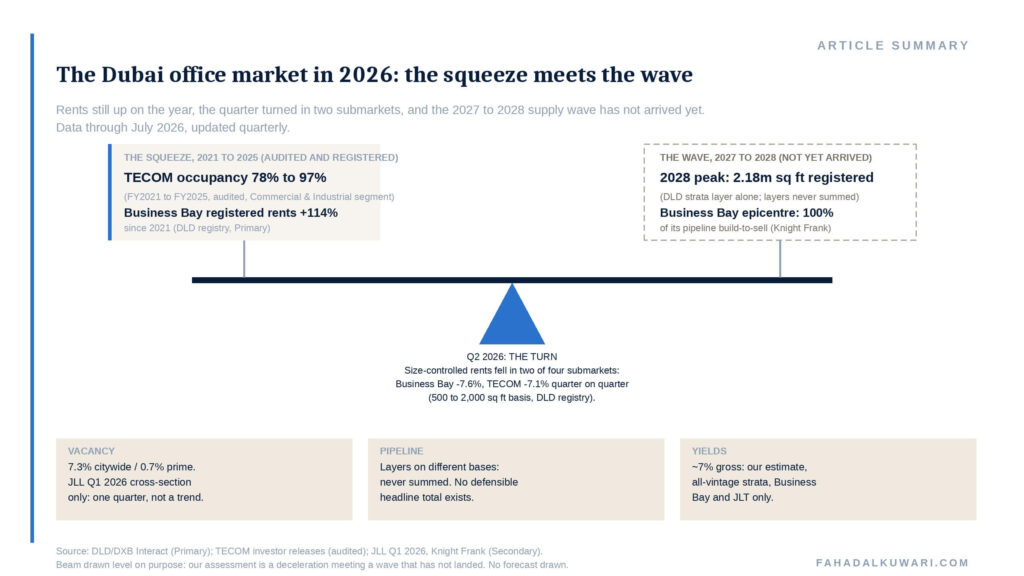
The squeeze of 2021 to 2025 was real, and part of it is audited: TECOM Group’s commercial occupancy rose from 78% in FY2021 to 97% in FY2025, and registered Business Bay rents more than doubled over the same years.
In 2026 the squeeze narrowed: registrations fell in every core district in the first half, and rents turned quarter on quarter in two submarkets. The supply that could change the market has not arrived yet.
Dubai office rents: the turn, with its basis
Dubai office rents are still rising year on year. On registered leases, controlled for unit size, first-half 2026 rents were +2.5% to +8.0% above a year earlier across core submarkets (DLD registry, through July 2026).
The quarter tells a different story. In Q2 2026, on the same size-controlled basis (contracts of 500 to 2,000 sq ft), Business Bay fell 7.6% quarter on quarter, TECOM 7.1% and JLT 2.1%, while Downtown rose 4.9%. Both are true: the yearly number still carries the strong quarters of late 2025; the quarterly number shows the turn.
The brokers read the same quarter three ways: CBRE +13% year on year, Savills flat quarter on quarter, Cushman & Wakefield down 2% on the quarter. These are different measures on different building sets, compatible, not conflicting, and this page will not average them.
The run-up was steep: registered rents since 2021 are up 114% in Business Bay and 91% in JLT. One district needs a split every time. Conventional Downtown rented at AED 270.5 per sq ft in 2025, the highest in the DLD dataset; the Trade Centre flexi segment at AED 169.9. The combined AED 178 mixes two products and is never a fair headline. More in Downtown’s two office markets.

Dubai office vacancy rate: still premium-priced, no longer the tightest
The Dubai office vacancy rate is 7.3% citywide, and 0.7% in prime buildings, per JLL’s Q1 2026 data. The same broker, in the same release: Riyadh 1.3% citywide and 0.5% prime; Abu Dhabi 1.4% and 0.1%. That is a one-quarter snapshot, not a trend. On it, Dubai is the loosest of the three Gulf capitals while its prime space stays effectively full: still premium-priced, no longer the tightest.
Two caveats travel with the citywide figure. JLL’s own numbers conflict: 7.1% in its Q3 2025 press release against 7.7% in later interview coverage, neither restated. And JLL attributes the vacancy rise, not the rent turn, to new deliveries. Prime vacancy ran 0.2% to 0.7% through 2025 and into 2026. Dubai’s 7.3% sits closer to London’s 7 to 8% than to its Gulf neighbours. Full three-city comparison: Dubai vs Abu Dhabi vs Riyadh.

Choosing between a prime lease and a strata purchase this year? The spread between 0.7% and 7.3% is the most useful number on this page. A one-hour registry read shows which side of it each building on your shortlist sits.
The Dubai office supply pipeline: a 2027 to 2028 wave
You will not find one headline pipeline number here. The Dubai office supply pipeline is published in layers that sit on different measurement bases, so any single total would be a number no source can defend.
Layer one is DLD-registered strata projects: 4,146 units and 6.64 million registered sq ft. Phasing: 0.14m sq ft in 2026, 1.31m in 2027, 2.18m in 2028, 1.46m in 2029, and 0.57m already overdue. Business Bay holds 2.0m sq ft of it; three Omniyat towers (Enara, Lumena, Lumena Alta) account for 1.66m, due 2027 to 2031.
Layer two is free zone projects, listed but never summed because their floor-area bases differ: DIFC Immersive Tower (about 630k sq ft converted, April 2027), DMCC’s One and Two Uptown Place (over 560k combined, Q1 2028), TECOM Innovation Hub Phases 3 to 4 (430k, 2027 to 2028), Design District Phase 2 (629k GFA, H1 2028).
The broker universes disagree even internally. Knight Frank’s two publications give 24.2m sq ft (2026 to 2030) and 13.2m sq ft by 2030. Both are shown; no blend is honest. Savills’ dated schedule runs 1.92m (2026), 1.67m (2027), 2.45m (2028), 3.20m (2029), 4.24m (2030).
One finding survives every universe: 2027 to 2028 is the concentration and Business Bay the epicentre, where Knight Frank counts 100% of the under-construction pipeline as build-to-sell. 2026 is the smallest delivery year on every published schedule; the wave is ahead, not here.

Pricing already reflects the build-to-sell model. Business Bay off-plan sales ran at a median AED 4,870 per sq ft from January to July 2026, a price that standing rents support at roughly 3% gross. That 3% is arithmetic, not a yield; it measures how far launch prices sit above the letting market.
Our estimate of true gross yields, all-vintage strata in Business Bay and JLT only, is about 7% in 2026, compressed from 8.8 to 9.8% in 2021; the only published figure is Property Monitor’s DIFC gross 6.11%. More in Business Bay office prices, office rental yields in Dubai and off-plan vs ready offices.
Grade A offices in Dubai: a shortage inside a Grade B city
Grade A offices in Dubai are scarce because the standing stock is old, not because the city is small. On Cushman & Wakefield’s classification, about 70% of standing stock is Grade B, while 72% of the pipeline is Grade A.

On demand, the registry’s audited anchor is TECOM Group: commercial occupancy 78% (FY2021), 94% (FY2024), 97% (FY2025), 98% (Q1 2026), then 97% in H1 2026. The series covers its commercial and industrial segment, not offices alone; the one-point dip is not, on its own, a turn.
DIFC grew from 2,437 active companies in 2019 to 10,018 by H1 2026, with workforce up 96% to 50,200. Its last hard occupancy number was 99.8% in FY2024, for owned-and-managed space only; it has published no numeric occupancy since, and no floor-area denominator. See DIFC office rents.
The 2026 flow points the other way. New registrations, January to June 2026 versus 2025: Business Bay down 13.3%, Downtown and Trade Centre down 13.2%, JLT down 12.6%, TECOM down 11.6%, citywide down only 5.1%, held up by flat legacy Deira.
One caveat on what a “lease” means here: 75.8% of 2025 new office leases in our extract are under 500 sq ft. Roughly a quarter of registered demand is licence-address registration (our assessment, size-based proxy: 26.3% of 2025 contracts in the six core submarkets).
Flexi demand is real demand, of a different kind; costs in flexi desk and Ejari licence costs. The blind spots are real too: no vacancy is published for any single submarket, occupancy exists for four of ten districts, and no source counts Dubai office jobs.
More in how to read Dubai office data yourself.
Outlook: three scenarios, no point forecasts
Our assessment of mid-2026: a demand-side deceleration is meeting the front edge of a supply wave that has not yet arrived. Registrations, company formation and size-controlled rents all slowed before the 2027 to 2028 deliveries, not because of them.
Three directions, none with point forecasts.
Base case: absorption with erosion. Citywide rents flatten, vacancy drifts up from 7.3%, prime holds.
Tight case: deliveries slip, as 0.57m sq ft already has, demand recovers with the Dubai PMI (51.6 in April 2026 to 56.9 in June, timing note only), and prime stays full.
Oversupply case: 2027 to 2028 lands on time into fading demand, Business Bay first.
Doha is the precedent, and its lesson is duration, not depth. Vacancy went from under 5% before 2009 to about 21% in 2011; rents fell roughly 75% peak to trough over a decade and were still falling, 2.2% year on year, at Q3 2025, fourteen years after the vacancy peak. Build-to-sell strata and legacy surplus cannot be withdrawn from a market; that is the risk this pipeline carries.
Two rules changed recently and neither is measurable yet.
Resolution No. 11 of 2025 lets free zone firms work onshore under new permits; its net effect on premises demand is unquantified.
The 15% DMTT top-up tax applies from 1 January 2025 to groups above EUR 750m revenue and is not yet visible in any published broker analysis.
No broker or authority attributes Dubai office demand to corporate tax, so no such claim appears here. The rules are mapped in free zone vs mainland office requirements.
Frequently asked questions
Are Dubai office rents rising or falling in 2026?
Both, on different bases. Year on year, size-controlled registered rents were up 2.5% to 8.0% in the first half of 2026. Quarter on quarter in Q2 2026, on a 500 to 2,000 sq ft basis, Business Bay fell 7.6% and TECOM 7.1%, while Downtown rose 4.9%.
What is the office vacancy rate in Dubai?
JLL puts Dubai citywide office vacancy at 7.3% in Q1 2026, with prime buildings at 0.7%. One internal conflict: JLL’s Q3 2025 press release said 7.1%, later interview coverage 7.7%, neither restated. No vacancy is published for any single submarket.
Is Dubai building too many offices?
The pipeline concentrates in 2027 to 2028, with Business Bay the epicentre, and its published figures sit on bases that cannot fairly be added up. Whether that is too much depends on demand then: base case rents flatten, tight case prime stays full, oversupply case starts in Business Bay.
What yield do Dubai offices pay?
Our estimate, gross, for all-vintage strata in Business Bay and JLT only: about 7% in 2026, down from 8.8 to 9.8% in 2021. The only published market figure is Property Monitor’s DIFC gross yield of 6.11%. Full working in office rental yields in Dubai.
Is Dubai still the tightest office market in the Gulf?
No. On JLL’s Q1 2026 cross-section, Dubai’s citywide vacancy of 7.3% is the highest of the three Gulf capitals, against Riyadh’s 1.3% and Abu Dhabi’s 1.4%. Dubai’s prime vacancy of 0.7% stays near full. Still premium-priced, no longer the tightest. This is a one-quarter snapshot, not a trend.
Weighing an office purchase or lease? I read the registry data on specific buildings before my clients commit. Fahad Al Kuwari, buyer’s consultant for Dubai offices, fahadalkuwari.com.
Data through July 2026. Primary sources: DLD/DXB Interact registry extracts; TECOM Group investor releases; DIFC publications; dlp.dubai.gov.ae. Broker figures (JLL, CBRE, Savills, Cushman & Wakefield, Knight Frank, Property Monitor) are secondary and attributed inline.
Share

Fahad Al Kuwari
Buyer Consultant Dubai Real EstateWith a deep commitment to providing personalized service, I specialize in helping buyers find the perfect property in Dubai. Whether you are looking for a luxurious waterfront villa, a modern penthouse, or a high-yield investment property, I’m here to make the process seamless and enjoyable.