
Is there a Dubai property bubble? Not in the 2008 sense. UBS rates Dubai “elevated” bubble risk, at 1.16, which is still below its “high” band. Bank exposure to property has fallen, and most buyers pay cash. But prices are high, rents for new tenants are falling, and a correction began in March 2026.
So where is the real risk? It sits in investor-owned off-plan apartments, bought on small deposits, in areas where many homes land in 2027 and 2028. Prime villas and ultra-prime homes, by contrast, tell a different story.
That is the short answer. In this guide I show the working. First, I explain what a bubble is. Then I go through what each major report actually said, where the hidden leverage sits, and what I would do at each level of the market.
Key takeaways
- The score: UBS rated Dubai 1.16 in September 2026. That is “elevated” bubble risk, 4th of 23 cities, but not “high”.
- Where the risk sits: the Dubai property bubble risk sits in investor-owned off-plan apartments, bought on small deposits, in high-delivery areas.
- Where the debt went: banks hold little of it. Instead, leverage has moved into developer payment plans and the payment due at handover.
- What has moved: the ValuStrat index was about 10% below February by September 2026. In my own lease records, new-lease rents fell 17% to 19% in Dubai Marina, Dubai Hills and Dubai Harbour, but only 3% for Villanova villas.
- The real test: the homes due in 2027 and 2028.
- Is there a Dubai property bubble? The short answer
- What a housing bubble actually is
- Four tests for a Dubai property bubble
- What the UBS bubble index and other reports really say
- When the developer becomes the bank: the leverage in off-plan payment plans
- What happens if an off-plan buyer cannot pay
- Is a Dubai property crash like 2008 coming?
- What the 2026 war did to Dubai property prices
- Two Dubai property markets: where the bubble risk sits
- The real Dubai property bubble test: homes landing in 2027 and 2028
- Three scenarios for Dubai property prices to 2028
- What I would do at each level of the market
- Dubai property bubble signals I am watching
- Dubai property bubble: frequently asked questions
- About the author
Is there a Dubai property bubble? The short answer
A bubble is when prices stay high only because buyers expect to sell higher later. In other words, rents and incomes no longer support the price. By that test, most of Dubai does not qualify. One part of it, however, might.
Dubai in October 2026: the key numbers
| Measure | Latest reading | Source |
|---|---|---|
| UBS bubble score | 1.16, “elevated”, 4th of 23 cities | UBS, 22 September 2026 |
| Price index (valuation-based) | 218.6 in September 2026, about 10% below February (243.4) and 4.5% below a year earlier | ValuStrat, September 2026 |
| Sales | About 34,500 homes in Q3 2026, down 4% on the quarter and 38% on a year earlier | Savills, Q3 2026 release |
| New-lease rents | 15.3% below January for the same building and unit type; renewals down about 1% | fäm Properties analysis of DLD data, via Khaleej Times |
| Bank exposure | About 18% of risk-weighted assets; most deals self-financed | IMF, 2 October 2025 |
Figures as published up to 16 October 2026.
So the market is correcting, not crashing. Also, the risk is not spread evenly, and that is the point most headlines miss.
How to read these numbers
Each source measures something different, so the numbers will not always match.
- ValuStrat is a valuation index. It tracks what valuers say homes are worth each month, not the price of every sale.
- Savills reports average prices and also “like-for-like” prices on the same type of home. In Q3 2026, average apartment prices fell 4.8% on the quarter, but like-for-like apartment prices fell only 1.7%. Some of the drop in averages is simply a change in what sold.
- Sales counts measure activity, not price. They can fall sharply while prices barely move.
- Rent figures differ too. Renewals, new leases and asking rents can all move at different speeds.
So I use each source for what it measures well, and I say which one I am quoting.

What a housing bubble actually is
Economists have argued about bubbles for a long time. Still, the clearest test comes from Joseph Stiglitz. A price is a bubble when it is high today only because people believe it will be higher tomorrow. In that case, the rent and the income behind it no longer explain it.
Robert Shiller adds the human side. Rising prices create stories, and those stories pull in buyers who expect the past to repeat. The loop then runs until it stops.
Hyman Minsky adds the money side. A boom turns dangerous when buyers can only pay if prices keep rising. At that point they are no longer paying from income. Instead, they are paying from the next sale.
So a real bubble needs more than high prices. First, prices must be cut loose from rent and income. Second, borrowed money usually pushes them further.

A bubble, a correction or a downturn?
People often mix up these three words, but they mean different things. In this guide I use them like this:
- Bubble bursting means a deep fall, often 30% to 60%, driven by forced selling and banks pulling back. Dubai saw this from 2008.
- Correction means a smaller repricing, often 5% to 20%. It takes the froth out without a banking crisis.
- Slow downturn means years of soft prices from too much supply and weaker demand. Dubai saw this from 2014 to 2020.
Today’s numbers fit the second word. The real question, then, is whether they slide into the third.
Four tests for a Dubai property bubble
Analysts use four simple tests, and UBS builds its index on similar ones. Below, I apply each one to Dubai, so you can judge the Dubai property bubble question for yourself.

Test 1: Price against rent
This test asks whether rent still pays for the home. UBS finds that a Dubai home costs about 16 years of rent. That is among the lowest of the 23 cities, and 16 years of rent implies a gross yield of about 6%.
But the trend has turned. UBS says real rents fell 4% in the year to Q2 2026, after inflation, while real prices rose 0.4%. Newer data is sharper still. An analysis of DLD data by fäm Properties found that rents on new leases, for the same building and unit type, are 15.3% below January. Renewals, meanwhile, moved by only about 1%. Savills tells a similar story by area. In Q3 2026, apartment rents fell 12.8% year on year in Dubai Marina, 12.2% in Business Bay and 10.4% in JVC.
When new tenants pay less, today’s yields will shrink at the next lease. So this test shows a warning sign. I tracked the same pattern at community level in my Dubai Hills Estate rent analysis, and in my study of how long it takes to find a tenant in Dubai Hills.

Test 2: Price against income
This test asks whether people who live here can afford to buy. According to UBS, a skilled service worker in Dubai needs about 5 years of average income for a 60 sqm flat near the centre. By comparison, London needs about 11 years and Hong Kong about 15.
There is a catch, though. Dubai’s buyers are not only residents. Many are foreign investors, and their income is not in the data. Even so, on this test Dubai looks cheap, not stretched. So there is no warning sign here.

Test 3: Debt
This is the test that breaks markets. For example, the US crash of 2008 was a debt crash, and so was Ireland’s.
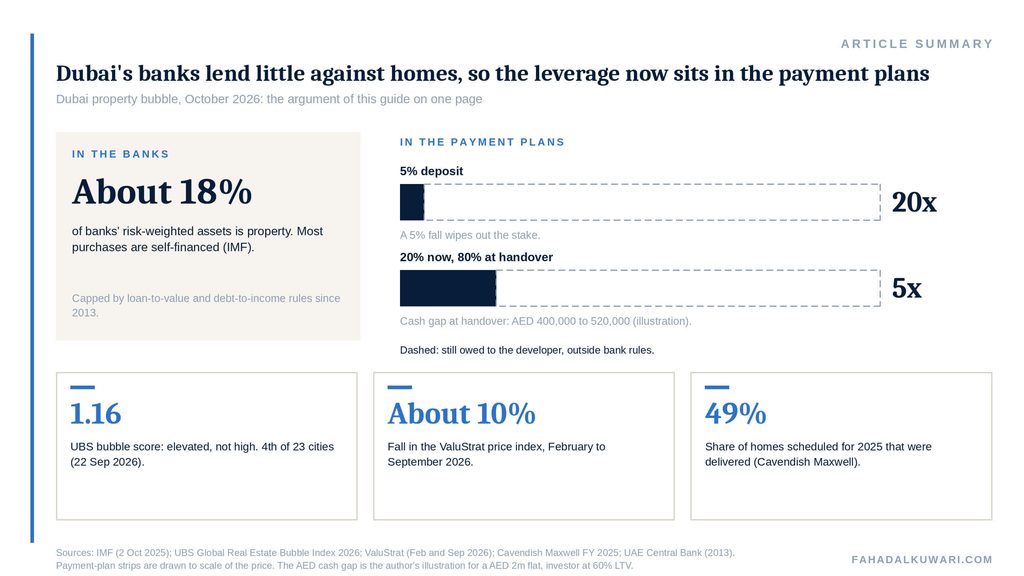
On bank data, Dubai passes. The IMF says banks’ exposure to real estate has fallen to about 18% of risk-weighted assets. It also says most deals are self-financed. Then, in July 2026, the IMF described bank exposure as “contained”, while it said market conditions warrant continued monitoring.
In short, the banks are not the engine, so there is no warning sign on bank data. Hold that thought, though. Bank data is not the whole picture, and I come back to it below.
Test 4: Speculation
This test asks whether buyers are betting on resale. About 7 in 10 Dubai sales are off-plan, according to Cavendish Maxwell’s Q3 2026 data. Investors, not future residents, buy many of these homes. Many also sit on small deposits and long payment plans.
None of that proves a bubble. However, it is the classic set-up for one, so this test shows a warning sign.
Two tests flash, and two do not. That is why the honest label is “overvalued, with a correction under way”, not “bubble”.

What the UBS bubble index and other reports really say
People quote every big report on the Dubai property bubble, and many misquote them. So here is what each one said, and what it did not say.

UBS Global Real Estate Bubble Index
UBS scores about two dozen big cities each September, and 23 in 2026. Its 2026 edition, published on 22 September 2026, put Dubai at 1.16. That is in the “elevated” band, and it ranks 4th of 23. A year earlier, Dubai scored 1.09 and ranked 5th of 21. In 2024 it scored 0.64. Back in 2023 it scored 0.14, and UBS called the market fairly valued.
Three things matter about this score:
- Most of the rise reflects 2025. Real prices rose more than 10% in 2025. In the year to Q2 2026, by contrast, they rose only 0.4%.
- The risk is easing. UBS says Dubai’s bubble risk has eased since March 2026.
- The index does not time anything. UBS says plainly that it does not predict when prices fall.
UBS also says Dubai is one of the few markets where owning is still relatively attractive, because renting is so expensive.
Fitch Ratings
In May 2025, Fitch expected a moderate correction from the second half of 2025 into 2026. It also said prices would fall no more than 15%. That 15% is a ceiling, not a forecast. Fitch’s reason was supply. It counted about 120,000 homes planned for 2026. It also expected housing supply to grow about 16% a year from 2025 to 2027, against about 5% population growth.
S&P Global Ratings
In October 2026, S&P said its base case is that Middle East disruption runs into 2027. It also warned that homes due in 2027 and 2028 could speed up the correction, mainly in investor-driven apartments. It did not, however, forecast a 2008-style collapse.
The IMF
The IMF’s October 2025 review said bank exposure had fallen and most deals were self-financed. Then, in July 2026, it said prices were generally at or above 2025 levels. Note the date, though. Since then, the ValuStrat index has dropped below its level of a year earlier, so that line has aged.
Citi
In March 2026, Reuters reported a Citi bear case. In it, prices fall an average of 7% a year between 2026 and 2028. That is the darkest published view I found. Still, it is a bear case, not Citi’s central forecast.
Read together, none of them describes a crash. Fitch, S&P and Citi’s bear case describe a correction. UBS makes no forecast, and the IMF’s July view came before the latest falls.
When the developer becomes the bank: the leverage in off-plan payment plans
Now back to debt. Bank data says Dubai is a cash market, and that is true. But it hides something, and it is the part of the Dubai property bubble debate most people miss.
Take a buyer who pays 20% during construction and 80% at handover. Or take a buyer on a 50/50 plan with a 5% deposit. Either buyer controls a whole home with very little of their own money. The rest is simply a promise to pay later.
So who carries that promise? Not a bank. The developer does. In effect, the developer lends to the buyer, interest free, and builds the cost into the price.
This is not only my view. Back in 2019, Sameer Lakhani of Global Capital Partners told Gulf News that developers had “stepped in to play the role of banks”. More recently, an academic paper, “When Developers Become Lenders”, studied Dubai as a case of credit growing outside the banking system.

Why this leverage is different
The central bank’s mortgage rules cover banks and finance companies that lend for homes. Since 2013, these rules have set clear caps:
- 80% loan-to-value for an expatriate’s first home up to AED 5 million. The cap began at 75% in 2013, and the central bank raised it in 2020.
- 60% for a second home.
- 50% for an off-plan home.
- Monthly debt payments of no more than 50% of income.
Developer’s payment plan, by contrast, is a sales contract, not a loan, so it sits outside those rules. As a result, a buyer who has paid 5% controls a home worth 20 times that amount. A 5% fall in value can then erase the whole deposit, before fees. The buyer may still owe the rest under the contract, so the loss is not always capped at the deposit. In short, this kind of exposure is something the bank rules would not allow.
My Dubai property payment plans guide explains the main plan types and how to judge one.
The handover cliff
The danger shows up on the day the big payment falls due. Here is a simple example.
An investor buys a AED 2 million flat on a 20/80 plan, so AED 1.6 million is due at handover. The investor plans to borrow it with a mortgage on the finished home. Because this is a second home, the cap is 60% of the bank’s valuation. The example assumes the bank approves the loan, and it leaves out fees.
- If the bank values the flat at AED 2.0 million, it lends AED 1.2 million. So the buyer must find AED 400,000 in cash.
- If the bank values it at AED 1.8 million, it lends AED 1.08 million. In that case the buyer must find AED 520,000.
First-home buyer at 80% would need nothing extra if the valuation holds, or AED 160,000 if it comes in 10% lower. But most off-plan buyers are investors, and many of them never planned for that cash.
The second test at handover: income
Valuation is only half the test. Under the central bank’s rules, the bank must also check that total monthly debt payments stay within 50% of the buyer’s income. The bank runs this check when the buyer applies for the mortgage, which for most off-plan buyers is close to handover. So the interest rates of that time apply, not the rates when the buyer signed.
Rates have moved since many of these plans were sold. In September 2026, the UAE central bank raised its base rate to 3.9%. So a buyer whose numbers worked in 2024 may now fail the income test, even if the valuation holds. In that case, the bank either lends less or declines.

How a correction can feed itself
This is how the loop works. First, prices fall. Next, bank valuations come in low. Then buyers cannot fund the gap, so some sell at a loss before handover. That adds supply just as new towers complete. I tracked what handover has done to prices before in my Dubai Hills Estate handover price study. Similarly, my Sobha Seahaven resale review shows how to read resales “below original price”.
What is softening the cliff
Banks are now moving earlier. In 2026, Emirates NBD signed off-plan financing deals with Sobha Realty and H&H Development. It also signed an MoU with Dubai Holding Real Estate (Nakheel, Meraas and Dubai Properties). As a result, some buyers can now get approval during construction, which cuts the risk of a surprise at handover. I reviewed H&H Development’s record on the DLD register in my guide to H&H Development.
Escrow also still protects the money that pays for construction. Under Law No. 8 of 2007, the developer’s creditors cannot seize buyer money held in a project escrow account. The escrow agent also holds back 5% of the account for a year after the homes are registered to buyers. Escrow does not, however, guarantee a handover date, a resale price or a rent. In March 2026, S&P said it expected no liquidity pressure at the four developers it rates, as reported by Kanebridge News. In my view, the risk is higher with smaller, unrated developers, where plans are often the most generous.
One honest gap
No public source shows how many buyers are on 20/80 or 5% plans. Nor does any source show how many miss their handover payment. I could not find it in any DLD or other public release. So I show the mechanism and the arithmetic, but I do not claim a default rate.
Before you sign an off-plan plan, stress-test it. Work out the cash you would need at handover if the bank valued the home 10% below your price. If that number would hurt, the plan is too big for you. I am happy to run that number with you.
What happens if an off-plan buyer cannot pay
Dubai’s law sets out what a developer may do when a buyer stops paying. The rule is Article 11 of Law No. 13 of 2008, as amended by Law No. 19 of 2017, and I checked it against the official text on the Dubai Legislation Portal.
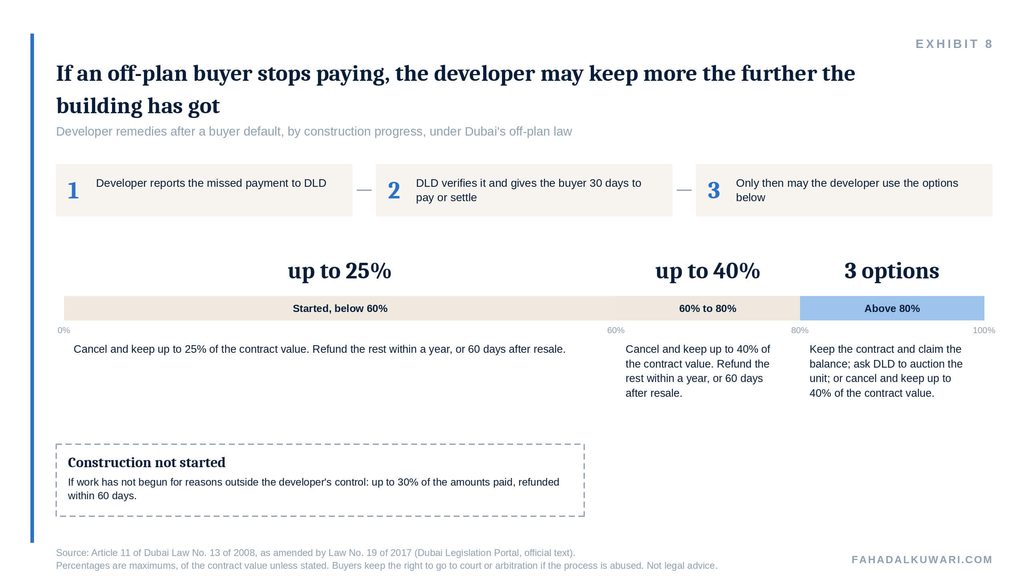
First, the developer must report the default to the Dubai Land Department. DLD then verifies it and gives the buyer 30 days to pay or settle. Only after that can the developer act, and what it may do depends on how far the building has got:
- Above 80% complete: the developer may keep the contract and claim the balance. Or it may ask DLD to auction the unit. Or it may cancel and keep up to 40% of the contract value.
- 60% to 80% complete: it may cancel and keep up to 40% of the contract value.
- Started, but below 60%: it may cancel and keep up to 25% of the contract value.
- Not started, for reasons outside the developer’s control and not its fault: it may keep up to 30% of the amounts paid.
Refunds and the buyer’s rights
These figures are maximums. When the developer cancels a contract, it must return any money above the deduction. It has until a year after cancelling, or 60 days after resale, whichever comes first. If building never started, the refund is due within 60 days. Buyers can also still go to court or arbitration if the developer abuses the process.
This section is general information, not legal advice. It follows the official English text, and the Arabic text prevails if the two differ. What applies to any one contract depends on its terms, the project’s verified progress and the procedure followed.
What this means for a 5% deposit
In practice, a developer can most easily keep what it already holds. So if a buyer has paid just 5% and the building is not yet 80% complete, that buyer may see walking away as a small loss. Once a building passes 80%, by contrast, the developer can hold the buyer to the full price.
Until then, tiny deposits are a risk for the whole building, not just one buyer. That is because cancelled units come back into a soft market. If you are weighing an off-plan purchase now, my guide to what to know before buying off-plan in Dubai sets out the questions to ask first.
Is a Dubai property crash like 2008 coming?
People ask me this more than anything else about the Dubai property bubble. My answer: Dubai’s rules and its mix of financing are very different from 2008, and that cuts the banking risk that broke it then. However, it does not remove the risk of a price fall, and Dubai has not fixed its off-plan habit.
In the 2008 to 2011 crash, prices fell by roughly half. Bank of America Merrill Lynch measured a 45% fall from the 2008 peak by 2010. A Reuters poll in 2011 then expected the total fall to reach 58%. The next downturn was slower. By Q2 2019, ValuStrat put prices 29.3% below their mid-2014 peak.

What is fixed
- Escrow. Buyer payments go into a project escrow account (Law No. 8 of 2007).
- Registration. Every off-plan sale goes on the DLD interim register (Law No. 13 of 2008).
- Bank limits. Since 2013, loan-to-value caps, a 50% cap on off-plan loans and a 50% debt limit apply.
- Cost of flipping. The DLD transfer fee doubled from 2% to 4% in 2013.
- Cash. Most deals are self-financed, so a bank crisis is far less likely.
What is not fixed
- Off-plan still dominates. About 7 in 10 sales are still off-plan.
- Leverage has moved. It left the banks and went into payment plans.
- Record supply sits in the schedule. Much of it slips into 2027 and 2028.
- Demand leans on newcomers. It depends on people and money arriving, and on Dubai feeling safe.
- Rates come from Washington. The US dollar peg ties the dirham to US rates. In September 2026, after a US move, the UAE central bank raised its base rate to 3.9%.
So a 2008-style collapse would need a debt spiral, and on today’s evidence that looks much less likely. A slower slide like 2014 to 2020 is the more realistic risk. Even then, it is most likely in some parts of the market rather than all of it.
What the 2026 war did to Dubai property prices
The conflict with Iran is the biggest shock this cycle, and it changed the Dubai property bubble picture. US and Israeli strikes on Iran began on 28 February 2026, and Iran struck the UAE the same day. Then a ceasefire took hold on 8 April. On 4 May, the UAE said Iran had attacked it again.
A US and Iran memorandum followed in June, but it broke down in July. As of 16 October 2026, the war has not ended. The US blockade of Iranian ports is back, and Iran says the Strait of Hormuz stays closed. There is still no peace deal.
Sales fell hard, prices much less
The market reacted the way a correction does, not the way a crash does.

- Sales: about 34,500 homes changed hands in Q3 2026, down 38% on Q3 2025 (Savills).
- Prices: the ValuStrat index was 4.5% below a year earlier in September 2026, and about 10% below February.
- Population: Dubai lost about 61,000 residents at the height of the war in March, a 1.3% dip. After that, it grew again, to 4,807,185 on 28 September 2026. That is 226,885 more than at the start of the year (Dubai Data and Statistics Establishment).
When sales fall faster than prices, it usually means sellers are holding out, not dumping. That is what you would expect where most owners have no bank loan to service. In short, the safe-haven story took a hit, but it did not break. People came back, and the top end kept trading.
How much of the fall is the war, and how much is supply?
No one can measure this exactly, because we cannot see a Dubai without the war. Still, two kinds of evidence give strong clues: the timing of prices, and my own lease records.
Prices first. Prices were still rising when the war began. The ValuStrat index reached 243.4 in February 2026, up 17.4% on a year earlier. Then, in March, it fell 5.9% in a single month. A sudden step like that is the mark of a shock, so that step is the war. Since March, by contrast, the index has drifted down only slowly, to 218.6 by September.
What my own lease records show
To test rents, I used the DLD records I keep for four communities: Dubai Marina, Dubai Hills Estate, Dubai Harbour and Villanova. I took every 12-month new lease registered from January 2025 to late September 2026, about 18,800 in all. I then compared rents only within the same building, so a cheaper tower cannot drag the average down.

Two findings stood out.
- The break came after the war began, not before. Through February 2026, new-lease rents were flat in all four communities. Then, between February and April, they dropped by about 11% in Dubai Marina and Dubai Hills, and by about 20% in Dubai Harbour.
- Local supply has made little difference so far. Dubai Marina has the least new building of the three apartment areas. Only 40% of its 2025 sales were off-plan, against 60% in Dubai Hills and 88% in Dubai Harbour. Yet from January and February to July to September 2026, Marina’s new-lease rents fell 17.4%. Dubai Hills fell 19.1%, and Dubai Harbour 18.8%. Meanwhile, villa and townhouse rents in Villanova fell only 3.4%.
So far, then, the rent fall looks mostly like a shock shared by all apartment areas, timed with the war. When about 61,000 residents left in March, apartment tenants were the quickest to move. By contrast, new supply close by has not yet shown up as a clear extra fall.
There are limits. These are four communities, mostly in the middle and upper market, so this is an estimate, not a citywide measure. Registrations also lag the decisions behind them. And supply landing anywhere in Dubai can pull tenants from every area at once, which this test cannot separate.
My read
The war explains the March price step, the fall in sales and, so far, most of the drop in new-lease rents. Supply explains the warning that came first: Fitch predicted a correction in May 2025, nine months before the first strike, because too many homes were due.
That matters for buyers. The war part can reverse quickly if peace comes. By contrast, most of the supply part has not arrived yet. Homes due in 2027 and 2028 will land either way, and that is when local supply should start to show in the numbers.
Two Dubai property markets: where the bubble risk sits
This is the most useful thing I can tell you about the Dubai property bubble. “Dubai” is not one market. In fact, the top and the middle are moving in opposite directions.

The top is still rising
- Prime homes rose 10.9% in the year to June 2026, on Knight Frank’s index. That put Dubai third of 46 cities. Note, though, that Dubai’s prime prices fell 1.0% in Q2 alone.
- Prime apartments rose 4.0% and prime villas 3.6% year on year in Q3 2026 (Savills).
- Sales above US$10 million reached 500 in 2025, worth US$9.05 billion, up from 435 in 2024 (Knight Frank).
The middle is giving ground
- All apartments fell 6.4% year on year in September 2026 (ValuStrat).
- All villas fell 3.4% over the same period.
The sources use different methods, so compare the direction, not the decimals. The direction, however, is clear. Scarce, cash-funded homes are holding, while mass-market apartments are giving ground. I looked at the top end in detail in my Dubai luxury real estate 2026 review.

Where Dubai property bubble risk is highest
When you put the four tests and the payment-plan risk together, a clear map appears.

Highest risk: mid-market off-plan apartments in high-delivery areas. Think of districts with large handover pipelines, such as JVC, Dubai South and Arjan. Here you find the most new supply and the smallest deposits. You also find the most investor owners and the most rent pressure. That is where the Stiglitz test can fail, because the buyer’s return depends on resale at handover, not on rent.
For JVC in particular, three of my studies give the detail:
- My JVC supply pipeline study shows how large that pipeline is.
- The JVC lease-up analysis shows how fast new towers find their first tenant, and why no one can publish a true occupancy rate.
- And the JVC sales decline study shows what sat behind the 39% fall in JVC apartment sales in H1 2026.
Middle risk: ready apartments in established towers. These face rent pressure from new competition. Still, most owners are cash buyers, so they can wait. My Business Bay investment review shows how this looks building by building.
Different risk: branded and ultra-prime homes. Here supply and leverage are low, so the risk is people. This segment depends on wealthy newcomers. UBS says uncertainty about the inflow of high earners is likely to weigh on the premium end. Meanwhile, Henley’s 2025 report forecast a net inflow of 9,800 millionaires to the UAE, the most of any country. Henley’s 2026 report, published in June, gave no UAE inflow figure. Instead, it said the conflict is testing the region’s wealth hubs, especially the UAE. Whether the flow resumes is the key question for this segment.
Lowest risk: prime villas in supply-tight communities. These have little new supply, mostly cash buyers, and end users who plan to stay.
The real Dubai property bubble test: homes landing in 2027 and 2028
Supply will decide the Dubai property bubble question more than any report. People throw supply numbers around a lot. Yet most of them are scheduled figures, not deliveries, and that difference matters.
Scheduled is not the same as delivered
Cavendish Maxwell tracks both. In 2025, developers scheduled 82,600 homes, yet only about 40,400 arrived, a 48.9% rate. Then, in the first half of 2026, 24,800 homes were completed. For the second half, about 47,000 are on the schedule, and Cavendish Maxwell expects 14,000 to 23,500 to arrive.

So when you read “120,000 homes in 2026”, read “scheduled”. About half tends to arrive on time. Most of the rest is not cancelled. Instead, it rolls into 2027 and 2028, and that is why S&P and others point to those two years as the real test.
Can the market absorb it?
Absorption is the other half of the story. Dubai’s population is still growing. If it keeps growing near recent rates, the market can take a lot of new homes. But if growth halves while the delayed homes all land, rents and prices in the delivery zones will feel it.
The same logic applies to smaller districts too. For example, I mapped the pipeline for Dubai Harbour and for Dubai Hills Estate.
Three scenarios for Dubai property prices to 2028
No one can time a market. What I can do, though, is set out the paths. For each one I give the conditions it needs and the signal that tells you it is happening. These are my scenarios, built from the reports above, not forecasts by any institution.

Base case
The war’s disruption runs into 2027, as S&P expects. Meanwhile, population keeps growing at 3% to 5% a year. In that case, investor apartments lose another 5% to 10%, while prime holds or edges up. The signal to watch: new-lease rents stop falling for three months in a row.
Bear case
The conflict drags on, population growth drops below 2%, and the delayed homes all arrive. Then mid-market apartments slide 20% to 30% over a few years, as Dubai prices did from 2014 to 2020. Smaller developers also come under strain. The signal to watch: resales below the original price spread across many projects.
Bull case
A lasting peace in early 2027 brings wealthy arrivals back. As a result, prices steady in 2027 and prime rises again. The signal to watch: new records in US$10 million+ sales, quarter after quarter.
What I would do at each level of the market
This is how I think about it with clients. It is not advice for your case, because that depends on your money, your timeline and your goals. For a wider framework, my guide on how to tell if a Dubai property is a good deal walks through the basics.
If you are buying off-plan in a high-delivery area
Be strict. First, price against ready resales nearby, not against the launch price. Second, model the handover cash at a valuation 10% below your price. Third, prefer developers with a long delivery record. And if the only reason to buy is resale at handover, think twice. My off-plan vs ready comparison for Dubai Hills shows how to test the discount.
If you are buying a ready apartment for income
Value it on today’s new-lease rents, not the current tenant’s rent, because the gap can be 15%. Also check how long units sit empty between tenants. My Dubai apartment vacancy study gives real waiting times, and my rent vs buy guide sets out the wider maths.
If you are buying prime or ultra-prime
This market is thin, with few buyers and big tickets. So prices can hold and still be slow to sell. Buy for the long hold, and buy what is scarce. Before you commit, check what homes in the project actually sold for on the register, as I did for Aman Residences Dubai.
If you already own off-plan and handover is coming
Get mortgage pre-approval now, not at the handover date. Then work out your cash gap at two valuations. If the gap is too big, plan a sale early rather than face a forced one late.
If you already own and wonder whether to sell
A 10% correction is no reason to panic if you have no debt and a long horizon. On the other hand, it may be a reason to sell if you carry leverage in a high-delivery zone and the next two years worry you. My portfolio stress-test guide walks through the questions, and my resale record study shows what sellers have actually made.
Dubai property bubble signals I am watching
I will update this Dubai property bubble guide each quarter against these ten signals:
- New-lease rents against renewals. When new leases stop falling, the base of the market is steady.
- Actual deliveries against schedule, especially in JVC, Dubai South and Business Bay in 2027.
- Population growth, monthly, from the Dubai Data and Statistics Establishment.
- Off-plan resales against original price. A spread of resales below cost would be the clearest sign that speculation is unwinding.
- The ValuStrat index, with apartments and villas read separately.
- Developer credit ratings and payment delays, especially for smaller developers.
- The UAE base rate, now 3.9%, and the share of deals that use mortgages.
- The war track: Hormuz and the US blockade, any US and Iran settlement, and flights at DXB.
- US$10 million+ sales counts from Knight Frank, as a gauge of wealthy arrivals.
- The UBS index in September 2027. A score below 1.0 would mean the imbalance has eased, while one above 1.5 would mean it has grown.
Dubai property bubble: frequently asked questions
Is Dubai in a property bubble in 2026?
Not in the 2008 sense. UBS rates Dubai “elevated” bubble risk at 1.16, below its “high” band. Bank exposure to property has fallen, and most buyers pay cash. Prices are high and a correction began in March 2026. The bubble-type risk is concentrated in investor-owned off-plan apartments in areas with heavy 2027 and 2028 deliveries.
Will Dubai property prices crash?
A 2008-style crash is unlikely because most deals are cash and bank exposure is contained, according to the IMF. Still, a correction is already under way: the ValuStrat index was about 10% below February 2026 by September. In mid-market apartments, a slower slide is possible if supply lands while population growth weakens.
What did the UBS bubble index say about Dubai?
The UBS Global Real Estate Bubble Index 2026, published on 22 September 2026, scored Dubai 1.16. That is “elevated” risk, fourth of 23 cities. Only Zurich and Tokyo were “high”. UBS said Dubai’s risk has eased since March 2026, and the index does not predict when prices fall.
Are off-plan payment plans risky in Dubai?
They can be. With a 5% deposit, a 5% fall in value can erase the deposit, and the buyer may still owe the rest. Developer plans are sales contracts, so bank loan limits do not cover them. The biggest risk is the handover payment, when the bank’s valuation and income test decide how much cash the buyer must find.
What happens if I cannot pay my off-plan instalments?
Under Article 11, the developer reports the default to DLD, which gives you 30 days to pay or settle. It may cancel and deduct up to 25% or 40% of the contract value from what you paid, by progress. If work never started, it may keep up to 30% of what you paid. Above 80%, it may claim the balance.
Is now a good time to buy property in Dubai?
It depends on what you buy. Prime and supply-tight villa homes are holding value. Mid-market off-plan apartments in high-delivery areas carry the most risk to 2028. For income, value a home on today’s new-lease rents. For off-plan, check the cash you would need at handover if the bank valued it 10% lower.
How is 2026 different from the 2008 Dubai crash?
Buyer money now goes into escrow, every off-plan sale is registered with DLD, and bank lending is capped. Most deals are cash. What has not changed is the high off-plan share, about 7 in 10 sales, and leverage that now sits in payment plans rather than in banks.
About the author
I am Fahad Al Kuwari, a Dubai property advisor, and I have worked in real estate since 2014. I write about the market from the public record, with sources, so you can check every number. If you want to test a purchase, a payment plan or a sale against the data in this guide, you can reach me through fahadalkuwari.com.
Talk to Fahad Al Kuwari, Dubai property advisor, at fahadalkuwari.com. Bring your plan or your unit, and we will run the handover numbers and the resale record together.
Share

Fahad Al Kuwari
Buyer Consultant Dubai Real EstateWith a deep commitment to providing personalized service, I specialize in helping buyers find the perfect property in Dubai and Abu Dhabi. Whether you are looking for a luxurious waterfront villa, a modern penthouse, or a high-yield investment property, I’m here to make the process seamless and enjoyable.