I hope you find this article insightful. If you’re looking for expert guidance on property investments in Dubai, feel free to reach out.
Author: Fahad Al Kuwari | Dubai Real Estate Consultant
Click here to get in touch with me directly.

A quarter of Mina Rashid’s resale record is not price discovery. Of 355 apartment resales registered since 2020, 87 print at exactly the price the developer charged for that same unit, and 84 of them match to the dirham. A Mina Rashid resale at original price, an at-OP print in market shorthand, has four honest explanations, and under every one of them the registered figure is not evidence of what the unit is worth today. The record cannot prove which explanation fits each print, but it shows something stronger: the data provider itself treats these prints differently. If you have been quoted a comp in this community, or you are pricing off a portal median, this is the caveat that changes the number.
The count comes from a simple test. Take every developer sale in the DLD extract, index it by building and unit, then check each resale price against the developer’s price for the same unit. Any resale within 0.1% counts as an at-original-price print, which this article calls an at-OP print. The test returns 87 of 355, or 24.5%. The clean, arm’s-length resale record of Mina Rashid is therefore 268 prints, not 355.
What a Mina Rashid resale at original price can be
An at-OP print has four honest explanations. All four are legal. All four are routine. And under all four, the registered price tells you nothing about what the unit is worth today.
An ownership re-registration. Dubai’s registry runs several transfer routes that are not sales. The Dubai Land Department lists property gift registration, known as Hiba, which moves a property to a first-degree relative or an owned company “without compensation”, at a fee of 0.125% of the valuation with a minimum of AED 2,000, per DLD. A market sale pays 4%. DLD also runs grant registration, inheritance transfer, and title deed modification as separate procedures, and its own open data splits transactions into sales, mortgages and gifts as distinct groups. Overseas guides sometimes call this a name transfer; the term is not one the local market uses. A family moving a unit between its own names has no reason to invent a new price. The original one is already on file.
A genuine flat exit. A seller really can close at the price they paid. This is an at OP resale in the plain sense: an off-plan buyer assigns the unit to a new buyer, the new buyer takes over the payment plan, and the contract price carries over. In a community where launch prices have climbed for six years, an early buyer who exits flat is still handing the new buyer a below-market entry. That trade is rational, and the tape shows it happens.
A partial-interest transfer. DLD’s gift procedure covers “full or partial” ownership, and adding or removing a co-owner requires a transfer or gift procedure of its own. The tape carries a visible trace of this: four resale prints sit at almost exactly half the developer’s price, two of them at 50.00% to the dirham. A half-share changing hands registers a price that no whole unit ever traded at.
A below-market sale registered at the valuation floor. The 4% transfer fee is charged on the sale price or DLD’s own valuation, whichever is higher, per Property Finder and Engel & Völkers guides. Practitioners in this market report a further step: when a deal closes well below the developer’s original price and that original price matches DLD’s valuation for the area, the transaction can register at the valuation rather than the lower contract price. The registration step is market-reported, not confirmed on any DLD service page, so treat it as directional, and the tape shows it is not a blanket rule, because losses down to 50% below cost do reach the register with computed gains. Where it applies, the real price sits below the print, which is one more reason the print is not a comp.
So which is which? Here is the honest limit of the data. The DLD extract behind this series carries no transaction-type field. The pattern is consistent with a non-sale registration category, and Dubai’s registry does keep those categories separate with a different fee, but the extract cannot prove which category any single print belongs to. This article will be updated if a transaction-type field becomes available for this data. What the extract can show is the next section.
How the tape tells an at OP resale from the rest
Every DLD resale row in this data carries a capital gain field. When a unit resells, the provider computes the gain over the developer’s price and prints it. This is where the 87 stop looking like ordinary sales.
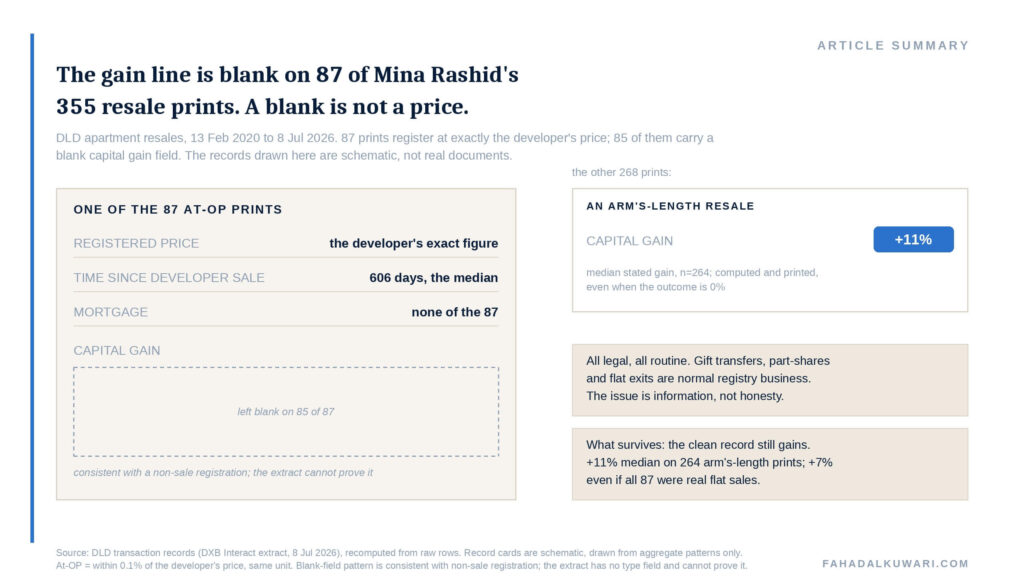
Of the 87 at-OP prints, 85 carry a blank gain field. Only 2 carry a computed figure, and both read +0%. Those two are what a genuine flat exit, or a below-market sale registered at the valuation floor, would produce: a real sale, processed as a sale, with its outcome computed. The 85 blanks are something else.
Now the control group. The gain field is not blank for flat sales in general. Ten prints sit between 0.1% and 1% from the developer’s price, and every one of them carries a computed gain: +0%, -0%, +1%, -1%. Across the whole tape, 24 resales print a gain of zero or plus or minus 1%. Strip out the partial-share artefacts and one mismatched row and 19 clean flat exits remain, most of them closed in 2025 and 2026. These are real sellers closing at or just under their cost, and the provider computes their outcome and prints it.
So the differential treatment is the provider’s own. Near-OP sale: gain computed. Exact-OP print: gain blank, 85 times out of 87. The blank field is consistent with records that enter the registry through a different door than a sale. That is as far as the evidence goes, and it is far enough, because either way the conclusion for a buyer is the same: a print whose gain field is blank and whose price equals the developer’s launch-era price is not evidence of market value.

Two more patterns separate the 87 from the 268. Not one of the 87 carries a mortgage, while 8 of the 268 arm’s-length resales do. And the 87 are not quick flips mislabelled: the median at-OP print lands 606 days after the developer’s own sale of that unit, with the shortest at 95 days and the longest at just over three years.
The scale, and where it sits
The 87 are recent. Seven printed in 2024, 43 in 2025, and 37 in 2026 up to 8 July. Four in five sit inside the last eighteen months. As a share of each year’s resales, at-OP prints were 6.9% in 2024, 28.3% in 2025, and 45.7% of 2026 so far. That last figure deserves a slow read: nearly half of this year’s registered resales in Mina Rashid print at exactly the developer’s price. The climb coincides with the community’s resale volume surge over the same period, which this series covers in the transaction history. Coincidence is all the data states.

By project, the 87 spread wide:
| Project | At-OP prints |
|---|---|
| Seascape | 15 |
| Ocean Point | 14 |
| Clearpoint | 13 |
| Marina Views | 10 |
| Ocean Star | 9 |
| Ocean Cove | 8 |
| Bayline | 5 |
| Avonlea | 5 |
| Marina Place 2 | 3 |
| Porto View | 2 |
| Sunridge | 1 |
| Pier Point | 1 |
| Seagate | 1 |
By bed type: 38 of 135 one-bed resales are at-OP, 40 of 177 two-beds, and 9 of 42 three-beds. That leaves an arm’s-length record of 97 one-beds, 137 two-beds and 33 three-beds. The thinner the segment, the more one at-OP print bends its median.
What phantom comps do to real decisions
The phantom here is the comp, not the person. Every at-OP print is a legal registration. The damage only starts when someone reads its price as evidence.
Marina Views 3BR is the autopsy this series keeps on file, covered in full on the Marina Views page. An earlier analysis showed asks running +57% over closes. That figure was a phantom-comp artefact. The only two arm’s-length closes in the tower’s 3BR stock were the same oversized unit trading twice, a variant the developer itself had priced 34% under its own grid, so there is no usable arm’s-length 3BR comp in the tower. The only other 3BR resale print is at-OP, with a blank gain field. Rebuilt against the right benchmark, the median of all 84 developer prints of standard 3BR stock at 3,157 AED per sqft, today’s 13 asks sit at a median of 3,365, or +6.6%. The market was never 57% apart from itself. The tape just contained two prints that were not comps, and one that was not a sale.

Ocean Point 3BR is the shorter version: both of its resale prints are at-OP. An earlier “+8% ask gap” restates as no tape at all.
If you are pricing a purchase or a sale off portal medians in this community, have someone strip the at-OP prints out of the comp set before you anchor on a number. It changes thin segments by real money.
What survives the cut
The honest core of the resale story survives, and it is worth stating plainly. On the clean 268-print base, the median stated resale gain is +11% (n=264 with a stated gain), and 85.2% of them are positive. By bed type, arm’s-length: one-beds median +9% (n=97), two-beds +15% (n=137), three-beds +10% (n=33). The handover price effect piece shows where those gains cluster.
One sensitivity bracket belongs in print, once. If every one of the 87 at-OP prints were a genuine flat sale, the community median gain would read +7% (n=351) instead of +11% (n=264). The evidence points against that reading: flat sales in this tape get their gains computed and printed, and 85 of the 87 do not, and none of the 87 carries a mortgage while the arm’s-length record does. But even at the pessimistic end of the bracket, the median resale in Mina Rashid closed above cost.
One caveat sits under both numbers, and it is the valuation-floor mechanism again. If a registered price can be a substituted valuation rather than the lower price actually paid, as practitioners report, then no bracket built from registered prices can see below it, and the true floor is unknowable from this data. The tape itself argues the substitution is not routine: 28 resales register losses, down to 50% below cost, and prints sit at every depth under the developer’s price with their gains computed. Low prices demonstrably do reach the register. The possibility still belongs in the open, and it cuts in one direction only: registered prices can overstate, not understate, what was really paid.
How a buyer checks a comp
DLD transaction data accuracy is high for what a record is; the risk is in what a reader assumes it is. Four pattern-level checks, none needing a unit number:
FAQ
What is a name transfer in Dubai property?
Name transfer is market shorthand for re-registering a property between related parties without a market sale. Dubai Land Department procedures include gift registration (Hiba) to first-degree relatives or owned companies, grant registration, and inheritance transfer. A gift pays 0.125% of valuation, minimum AED 2,000, against 4% for a sale, per DLD.
Is it legal to resell at the original price?
Yes. An owner can sell at any price both sides accept, including exactly what they paid. In Mina Rashid the tape shows 19 clean flat exits with computed gains near zero, mostly in 2025 and 2026. Early buyers exiting flat still hand the new buyer a below-launch-ladder entry.
How common are at-OP prints in Mina Rashid?
Of 355 apartment resales registered from 2020 to 8 July 2026, 87 print at the developer’s exact price, which is 24.5%. Their share is rising fast: 6.9% of 2024 resales, 28.3% of 2025, and 45.7% of 2026 registrations to date, per DLD transaction data.
Do at-OP prints distort portal price averages?
Yes, wherever medians are thin. At-OP prints carry launch-era prices, so they pull recent medians toward old pricing. In Mina Rashid they are 87 of 355 resale prints, and in small segments the effect is decisive: one tower’s three-bed “comps” dissolve entirely once at-OP prints are removed.
How can I tell if a comp is a real sale?
Check the capital gain field on the transaction record. Real resales in this dataset carry a computed gain, even when it is 0%. At-OP prints carry a blank in 85 of 87 cases. Then check whether the price exactly matches the project’s launch-era developer pricing.
What fee does a Dubai property gift transfer pay?
Dubai Land Department charges 0.125% of the property valuation for gift registration between first-degree relatives or to an owned company, with a minimum of AED 2,000, plus fixed title deed and map fees, per DLD’s published service page. A standard sale transfer pays 4% of the price.
Data through 8 July 2026 (DLD), updated quarterly. The at-OP test and every count above were recomputed from transaction-level DLD records for this article. This is not investment advice.
If you want a comp set with the at-OP prints stripped out before you buy or price a sale, I do that work daily. Fahad Al Kuwari, buyer’s consultant for Mina Rashid, fahadalkuwari.com.
Share

Fahad Al Kuwari
Buyer Consultant Dubai Real EstateWith a deep commitment to providing personalized service, I specialize in helping buyers find the perfect property in Dubai. Whether you are looking for a luxurious waterfront villa, a modern penthouse, or a high-yield investment property, I’m here to make the process seamless and enjoyable.